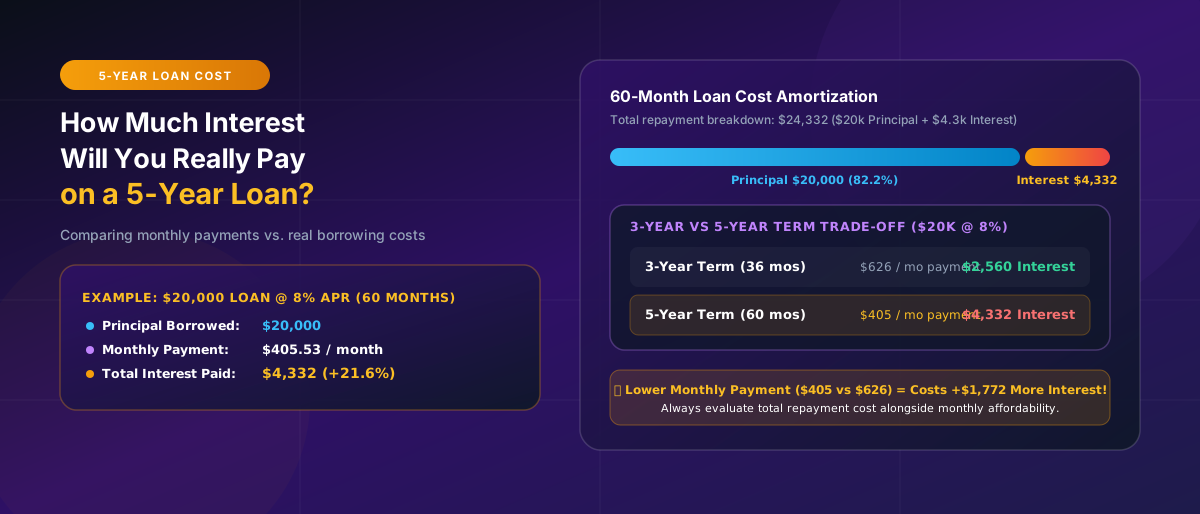
A lower monthly payment doesn't automatically mean a cheaper loan. Extending repayment over 5 years (60 months) lowers your monthly bill but increases the total interest paid over time. Always evaluate total borrowing cost alongside monthly affordability.
When you take out a loan, the monthly payment is usually the number that gets your attention first. A lender might tell you, “Your payment will be around $400 a month,” and that can sound manageable.
But there is another number that can be much more important: how much you will pay in total.
A five-year loan can look affordable because the payment is spread across 60 months. However, every payment usually includes both principal and interest. By the time the loan is completely paid off, you may have paid thousands of dollars more than the amount you originally borrowed.
Understanding the total interest before you sign a loan agreement can help you decide whether the loan actually fits your finances (see how to calculate the real cost of a loan).
Why the Monthly Payment Doesn't Tell the Whole Story
Suppose you borrow $20,000. If someone only tells you that your payment is about $405 per month, you might think, “That doesn't sound too bad.”
But $405 paid every month for 60 months adds up to more than $24,000.
The difference between what you borrowed and what you repay is largely the cost of borrowing, including interest. This is why you should look beyond the monthly payment and examine the loan's total cost.
A lower monthly payment isn't automatically a cheaper loan. A longer repayment period can reduce the monthly payment while increasing the amount of interest you pay over time (see why loan payments can be higher than expected).
An Example: A $20,000 Loan Over Five Years
Let's use a simple hypothetical example.
Imagine you borrow $20,000 at an annual interest rate of 8% and repay it over five years, with monthly payments.
5-Year Loan Breakdown Example ($20,000 @ 8% APR)
- Loan Amount (Principal): $20,000
- Interest Rate: 8% annually
- Loan Term: 5 years (60 months)
- Approximate Monthly Payment: $405.53
- Total Payments (60 × $405.53): ~$24,332
- Total Interest Paid: ~$4,332 (+21.6%)
Result: You borrowed $20,000 but repay roughly $24,332 over the life of the loan. The $4,332 difference represents the true interest cost.
The exact amount can change depending on the lender, fees, payment schedule, and other loan terms. That's why calculating the actual numbers for your specific offer matters.
What Determines How Much Interest You Pay?
Several factors work together to determine the total cost of a loan.
1. The Amount You Borrow
The larger the loan, the more interest you can potentially pay. Borrowing $30,000 will generally cost more in interest than borrowing $10,000 when the rate and repayment period are otherwise similar.
This is one reason it can be useful to borrow only what you genuinely need rather than automatically taking the maximum amount a lender offers.
2. Your Interest Rate
Your interest rate has a major impact on the cost of borrowing. A lower rate generally means less interest over the life of the loan, while a higher rate can make the same loan significantly more expensive.
Your credit history (see what is a good credit score), income, debt levels (see debt-to-income ratio), loan type, lender, and market conditions can all influence the rate you receive.
3. The Loan Term
The term is how long you have to repay the loan. A five-year loan has 60 monthly payments.
If you stretch the same debt over a longer period, your monthly payment may fall, but you could pay more interest overall because the balance remains outstanding for longer.