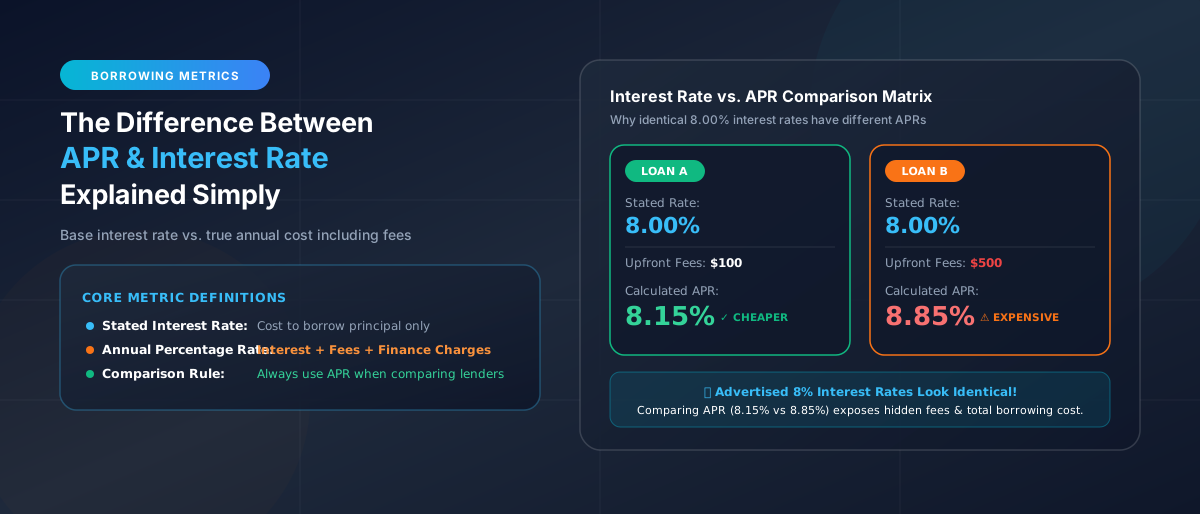
The interest rate measures the cost of borrowing the principal balance. The APR (Annual Percentage Rate) incorporates both the interest rate and mandatory lender fees, providing a broader, standardized measure for comparing loan offers.
When you're comparing loans or credit offers, you may see two numbers that look almost identical: the interest rate and the APR.
At first, it can be confusing. If a lender advertises a loan at 8%, you might assume that's the full cost of borrowing. But the interest rate and APR don't necessarily tell you the same thing.
Understanding the difference can help you compare loan offers more accurately and avoid focusing only on the number that looks attractive in an advertisement.
What Is an Interest Rate?
The interest rate is the percentage a lender charges for allowing you to borrow money.
For example, imagine you borrow $10,000 at an annual interest rate of 8%. The lender uses that rate to calculate the interest charged on the outstanding balance according to the loan's terms.
The actual amount of interest you pay isn't simply 8% of $10,000 every year because installment loans are typically paid down over time. As the principal balance decreases, the interest charged can also decrease.
That's why the interest rate alone doesn't tell you exactly how much the loan will cost from beginning to end.
So, What Is APR?
APR stands for Annual Percentage Rate.
APR is intended to give you a broader picture of the cost of borrowing. Depending on the loan and applicable rules, it can incorporate the interest rate along with certain finance charges or fees.
For example, suppose two lenders offer loans with the same advertised interest rate. One lender charges significant upfront fees while the other charges fewer fees. Their APRs may be different even though their stated interest rates are identical.
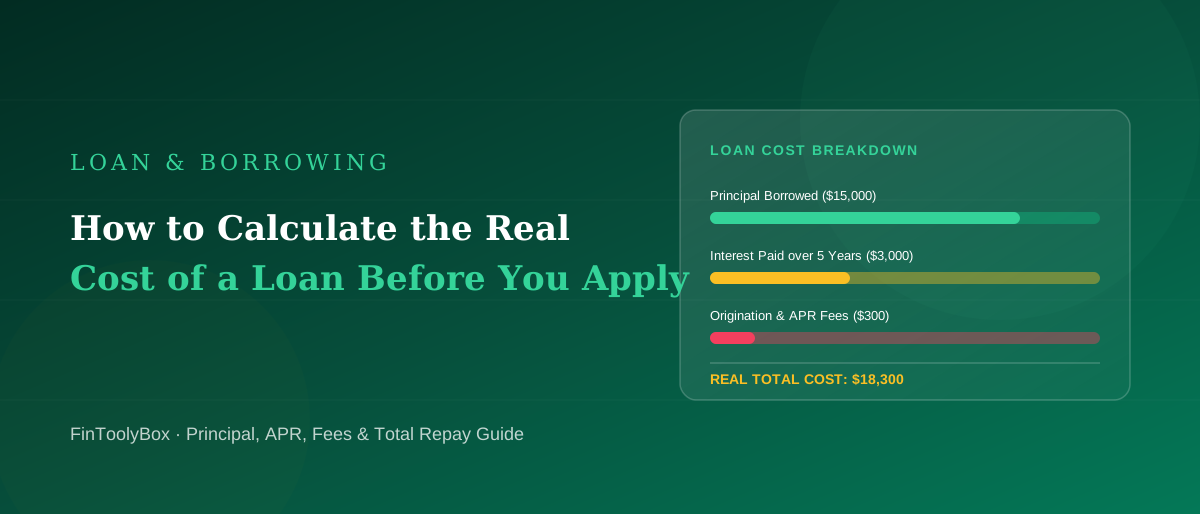
This is one reason APR can be useful when you're comparing offers (see how to calculate the real cost of a loan).
| Metric | Primary Focus | Costs Included | Best Use Case |
|---|---|---|---|
| Interest Rate | Base cost of borrowing money principal. | Interest rate percentage only. | Calculating exact monthly principal & interest payment. |
| APR (Annual Percentage Rate) | Total standardized annual cost of borrowing. | Interest rate + Origination fees + Processing charges. | Accurately comparing different lender offers side-by-side. |
Interest Rate vs. APR in Simple Terms
A simple way to think about it is:
- Interest rate: focuses primarily on the cost of borrowing the money.
- APR: provides a broader measure that can include the interest rate and certain additional borrowing costs.
Neither number should automatically be treated as the complete amount you will spend. Your loan agreement may contain other costs or conditions that affect your actual expense.
Here's a Simple Example
Imagine you're comparing two hypothetical loan offers for the same amount ($10,000 over 3 years) and repayment period.
Loan Offer Comparison Example
- Loan A: Stated Interest Rate: 8.00% | Upfront Fees: $100 | APR: 8.15%
- Loan B: Stated Interest Rate: 8.00% | Upfront Fees: $500 | APR: 8.85%
If you only look at the interest rate (8.00%), both offers appear identical. Looking at the APR reveals that Loan B costs significantly more due to $500 in hidden fees.
Looking at the APR reveals that Loan B has a higher overall borrowing cost because of the additional charges included in the APR calculation.
This doesn't necessarily mean Loan A is always the better choice. You still need to look at the actual fees, payment schedule, loan term, and other conditions.
Why Lenders Advertise Interest Rates
Interest rates are easy to understand and make it simple to advertise loan products.
You might see phrases such as “rates as low as 7.5%” in advertisements. But the lowest advertised rate may only be available to borrowers who meet particular requirements.
Your actual rate can depend on factors such as your credit profile (see what is a good credit score), income, existing debts (see debt-to-income ratio), loan amount, loan type, repayment period, and the lender's criteria.
That's why you shouldn't assume that an advertised rate is necessarily the rate you'll receive.
Why APR Matters When Comparing Loans
Imagine you're shopping for a personal loan, auto loan, or mortgage.
You could compare several offers by looking only at their interest rates. But if one loan comes with higher applicable fees, that comparison may not give you the full picture.
Checking APR can make the comparison more meaningful because it can account for certain costs beyond the stated interest rate.
However, you should still read the loan disclosure carefully. APR doesn't necessarily capture every cost associated with owning or using a financial product.
Does a Lower APR Always Mean a Better Loan?
Not necessarily.
A lower APR can be helpful when comparing similar loan products under similar terms, but you shouldn't make a decision based on APR alone.
Consider the following:
- The total amount you'll repay
- The monthly payment
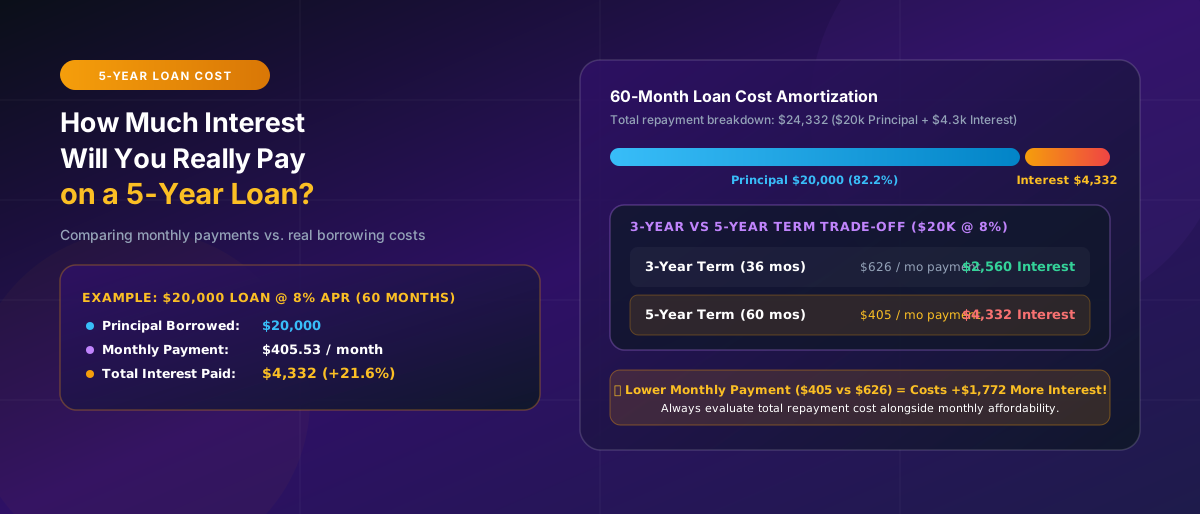
- The length of the loan (see how much interest you really pay on a 5-year loan)
- Upfront fees
- Late-payment charges
- Prepayment rules
- Whether the interest rate is fixed or variable (see fixed vs variable interest rates)
- Any other costs or conditions
A loan with a slightly higher APR could potentially make more sense in a particular situation if it offers terms that better fit your needs. The important thing is to understand what you're actually agreeing to.
APR Can Be Especially Useful When Fees Differ
Fees can make loan comparisons surprisingly difficult.
One lender might advertise a lower interest rate but charge several upfront costs. Another might advertise a slightly higher rate but have fewer applicable fees.
If you only compare the interest rates, you may choose the wrong offer based on incomplete information.
APR helps bring some of those costs into the comparison, making it easier to see that the lowest interest rate isn't necessarily the lowest-cost borrowing option.
Don't Confuse APR With Your Total Interest
Another common mistake is assuming APR tells you exactly how much interest you'll pay over the life of the loan.
It doesn't.
The total interest you pay depends on factors such as the loan balance, interest rate, repayment schedule, and loan term. APR is primarily a standardized measure designed to help compare borrowing costs.
If you want to know exactly how much you'll pay, look at the loan's payment schedule and calculate the total payments and total interest.
Short-Term Loans Can Make Comparisons Tricky
Loan term matters when you're comparing APRs.
A loan with certain fees may show a relatively high APR when those costs are spread over a short repayment period. The same type of fee could have a different effect on APR over a longer term.
For this reason, try to compare loans with similar amounts and repayment periods whenever possible.
10 Checklist Questions Before Accepting a Loan Offer
- How much money am I actually borrowing?
- What is my exact interest rate?
- What is the APR?
- How much will I pay each month?
- How many payments will I make?
- What is the total amount I'll repay?
- How much of that total is interest?
- Are there additional fees (origination, processing, admin)?
- Can I repay the loan early without a penalty?
- Is the rate fixed or variable?
Use a Loan Calculator to See the Real Cost
A loan calculator can make the numbers easier to understand.
Enter the loan amount, interest rate, and repayment period. Then compare the estimated monthly payment, total payments, and total interest.
You can also experiment with different loan terms. For example, changing a five-year loan to three years may increase the monthly payment but reduce the amount of interest paid over time.
This helps you see the trade-off before you commit.
The Bottom Line
The interest rate and APR are related, but they aren't the same thing.
The interest rate primarily tells you the rate charged for borrowing money, while the APR is designed to provide a broader measure of borrowing costs by incorporating the interest rate and certain applicable fees or finance charges.
When comparing loans, don't focus on just one number. Look at the APR, total repayment amount, monthly payment, loan term, fees, and other conditions.
The best loan isn't necessarily the one with the lowest advertised rate. It's the one whose overall cost and repayment terms make sense for your financial situation.
Disclaimer: This article is for general educational purposes only. APR calculations and the fees included can vary depending on the type of financial product and applicable regulations. Always review the lender's disclosures and loan agreement before making a financial decision.