Never judge a loan by its advertised monthly payment alone. Always multiply monthly payments by the total loan term (in months) and add all upfront origination fees to calculate the true total repayment cost.
Taking out a loan can make an important purchase possible when you don't have enough cash available right now. Whether you're buying a car, paying for a major home project, covering an unexpected expense, or financing another large purchase, borrowing can be useful.
But there is one mistake many borrowers make: they look only at the monthly payment. A loan advertised as "$300 per month" might sound affordable, but that number doesn't tell you how much the loan will actually cost you over time.
Before accepting a loan, it's worth looking beyond the monthly payment and calculating the total cost of borrowing. Once you understand the full cost, it becomes much easier to compare different loan offers and decide whether the loan fits your budget.
What Makes Up the Cost of a Loan?
The amount you borrow is called the principal. However, the principal is usually not the amount you eventually pay back.
Most loans include interest, which is the cost charged by the lender for allowing you to use its money. Depending on the loan, you may also encounter application fees, origination fees, closing costs, late-payment fees, or other charges.
So, when calculating the real cost of a loan, you should consider at least three things: the amount borrowed, the interest paid, and any additional fees.
Start With the Principal
The first step is to determine exactly how much money you are borrowing. Suppose you want to borrow $10,000.
That $10,000 is your starting principal. If the lender charges interest and fees, your total repayment will be higher than $10,000.
It is important to remember that a loan can have a relatively small monthly payment while still costing a lot over its entire repayment period.
Look at the Interest Rate
The interest rate is one of the most important numbers to examine before taking a loan. It determines how much interest is charged on the outstanding balance according to the loan's terms (see our EMI calculation guide).
For example, imagine two lenders offer you a $10,000 loan. One offers a 7% annual interest rate while another offers 12%. If the other terms are similar, the 7% loan will generally cost less in interest.
However, don't compare interest rates alone. A loan with a lower advertised rate could still be more expensive if it comes with significant fees.
Understand the APR
This is where APR, or annual percentage rate, can be helpful. Depending on the type of loan and the rules that apply in your location, APR can incorporate the interest rate and certain borrowing costs, making it a useful number for comparing offers.
If two loans have similar repayment periods, comparing their APRs can give you a better idea of which borrowing option may be more expensive.
However, always check what is included in the APR calculation and read the lender's terms. Not every possible cost is necessarily represented in the same way.
Don't Ignore the Loan Term
The loan term is the amount of time you have to repay the money. It can have a major effect on the total amount you pay.
Consider a hypothetical $20,000 loan. A shorter repayment period might result in larger monthly payments, but you could pay less total interest because the debt is repaid sooner.
A longer term can make the monthly payment smaller, which may seem attractive. However, you could end up paying interest for several additional years.
| Loan Term | Monthly Payment | Total Interest Paid | Total Repayment Cost |
|---|---|---|---|
| 3 Years (36 mos) | $617 | $2,228 | $22,228 |
| 5 Years (60 mos) | $396 | $3,760 | $23,760 |
| 7 Years (84 mos) | $302 | $5,385 | $25,385 |
This is why you should never judge a loan solely by its monthly payment. Always ask yourself: How much will I pay in total by the time this loan is completely paid off?
A Simple Worked Example
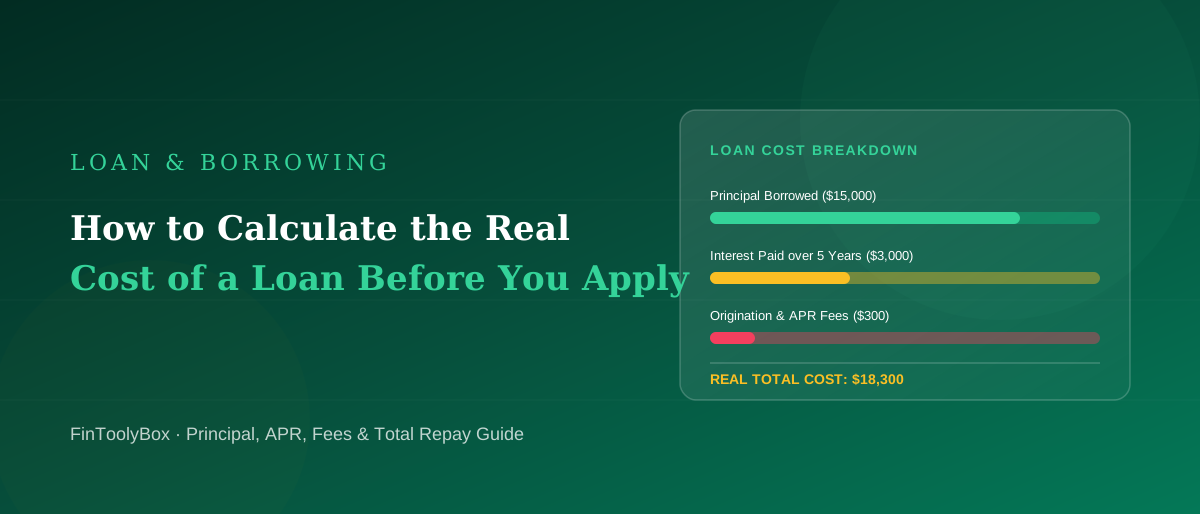
Imagine you borrow $15,000 at a fixed interest rate and agree to repay it over five years. Your lender gives you a monthly payment of approximately $300.
5-Year $15,000 Loan Cost Calculation
- Monthly Payment: $300
- Total Repayment Period: 60 Months (5 Years)
- Total Payments: $300 × 60 = $18,000
- Total Interest Cost: $18,000 − $15,000 = $3,000
That difference between the $15,000 you borrowed and the $18,000 you repay represents $3,000 in interest. This simple calculation immediately gives you a better understanding of what the loan is costing you.
Check for Additional Fees
Interest isn't always the only expense associated with borrowing. Depending on the loan, you might encounter fees such as an origination fee, application fee, documentation fee, annual fee, or early repayment charge.
Some fees may be deducted from the amount you receive. For example, if you are approved for a $10,000 loan but the lender charges a $300 origination fee, you may receive less than $10,000 while still being responsible for repaying according to the loan agreement.
Always read the loan agreement carefully and ask the lender to explain any charge you don't understand.
Use a Loan Calculator
Manually calculating a loan can become complicated when interest compounds according to a specific schedule and the payment is spread across many months.
A loan calculator can make the process much easier. You typically enter the amount borrowed, interest rate, and repayment term, and the calculator can estimate the monthly payment and total interest.
This can be especially useful when comparing several loan offers. Instead of looking at each lender's monthly payment separately, you can compare the estimated total cost of each option.
Ask Yourself Whether the Payment Fits Your Budget
Even if a lender approves you for a loan, that doesn't necessarily mean the loan is comfortable for your budget.
Before borrowing, look at your existing monthly commitments. Consider housing, food, transportation, insurance, utilities, subscriptions, existing debt, and savings goals (using the 50/30/20 budgeting rule).
Then see how the new loan payment would fit into your normal monthly spending. Leave some room for unexpected expenses rather than using every available dollar to make the payment.
Compare More Than One Loan
If possible, get quotes from multiple lenders before making a decision. Compare the interest rate, APR, loan term, monthly payment, total repayment amount, and fees (see our personal loan vs credit card guide).
A loan with a slightly higher monthly payment could actually save you money overall if it has a shorter term and lower total interest.
Looking at the complete picture can prevent you from choosing a loan simply because its advertised monthly payment looks attractive.
Final Thoughts
The real cost of a loan is much more than the monthly payment printed in an advertisement. To understand what you're actually paying, consider the principal, interest rate, APR, repayment period, fees, and total amount you will repay.
Before signing a loan agreement, take a few minutes to calculate the total cost and compare it with other available options. A payment that looks affordable today can become expensive when spread over several years.
The more clearly you understand the numbers before borrowing, the easier it becomes to choose a loan that fits both your immediate needs and your long-term financial plans.
Sources & References
This loan guide relies on consumer protection standards and regulatory lending disclosures. For official resources, visit:
- Consumer Financial Protection Bureau (CFPB) Know Before You Owe
- Federal Trade Commission (FTC) Credit and Loans Guide
- FINRA Personal Borrowing and Loans Education
Frequently asked questions
Why is looking only at the monthly loan payment dangerous?
A low monthly payment can be achieved by stretching the loan over a longer term, which drastically increases the total amount of interest you pay over the life of the loan.
What is the difference between Interest Rate and APR?
The interest rate is the percentage charged on the principal balance. The APR (Annual Percentage Rate) includes both the interest rate and mandatory lender fees (like origination or processing fees), giving you a more complete cost comparison.
How do origination fees affect the net loan amount received?
If a lender charges a 3% origination fee on a $10,000 loan, $300 is deducted upfront, meaning you only receive $9,700 cash while still owing and paying interest on the full $10,000 principal.
Helpful resources
Internal resources
- How EMI Is Calculated
- Car Loan Interest Rates Guide
- Personal Loan vs Credit Card
- Debt Consolidation Guide
- Loan Prepayment Guide
- Browse all articles