If you have ever searched for an EMI calculator or asked how EMI is calculated, you are looking for one of the most practical loan questions in personal finance. EMI — Equated Monthly Installment — is the fixed monthly payment on many amortizing loans for homes, cars, education, and personal borrowing.
This guide explains the authentic EMI formula, a full worked example, how amortization splits interest and principal, what changes total interest, and how to avoid confusing a low EMI with a cheap loan. For related money math, see how compound interest works and our loan calculators.
What does EMI mean?
💡 Author Analyst Observation: What Is Easy to Overlook
What many borrowers miss during early loan years is how much of each monthly payment goes toward interest versus principal. Making small extra principal prepayments early reduces the remaining balance and cuts total interest costs dramatically.
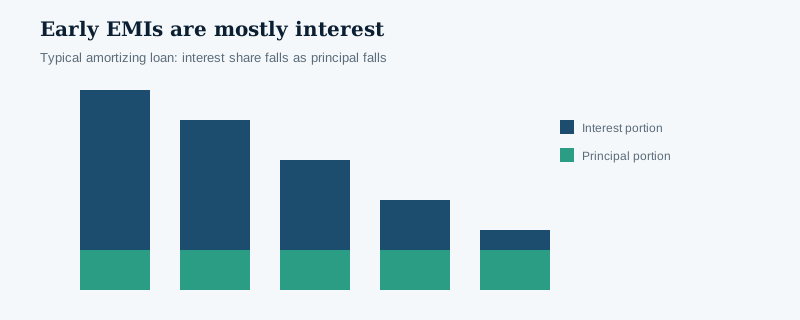
EMI means a level monthly payment for a fixed number of months. In a standard reducing-balance loan, each EMI contains two parts: interest for the month and principal repayment. The payment amount stays the same, but the mix changes over time — early months are interest-heavy; later months retire more principal.
Early in a reducing-balance loan, over 70% of your EMI goes toward interest rather than principal. Making even small extra principal payments in years 1 to 3 drastically reduces total interest paid over the life of the loan.
Different countries use different product names (mortgage payment, installment loan, hire purchase), but the core reducing-balance mathematics is widely shared. Fees, insurance add-ons, floating-rate resets, and legal disclosures still differ by lender and jurisdiction.
Why people search for EMI calculators
- To estimate monthly budget impact before applying
- To compare loan offers with different tenures
- To see total interest over the full term
- To test prepayment scenarios
- To understand whether stretching tenure is worth the lower payment
A good EMI calculator does not only print a monthly number — it helps you see total cost. That is the same philosophy behind FinToolyBox tools.
The standard EMI formula
- P = loan principal
- r = monthly interest rate = annual rate ÷ 12 (as a decimal)
- n = number of monthly installments
Example: 12% per year → r = 0.12 / 12 = 0.01 per month.
This is the classic formula for a fixed-rate, fully amortizing loan with payments at the end of each month. Some products use daily rates, flat-rate marketing, or interest-only periods — those need different math. For consumer-loan concepts and repayment rights in the U.S. context, the Consumer Financial Protection Bureau Ask CFPB library is a useful external reference; always pair it with your local regulator’s guidance.
Worked example: 100,000 at 12% for 5 years
Inputs
P = 100,000 · annual rate = 12% · tenure = 5 years · n = 60 · r = 0.01
Total paid ≈ 2,224.45 × 60 ≈ 133,467
Total interest ≈ 33,467
If you stretch the same loan to 10 years (n = 120), the EMI falls, but total interest usually rises. Lower monthly pressure is not automatically cheaper.
How amortization works month by month
- Interest due = outstanding principal × monthly rate
- Principal repaid = EMI − interest due
- New principal = old principal − principal repaid
Repeat until the balance reaches zero. That schedule is why prepaying principal early usually saves more interest than paying the same amount near the end of the loan.
EMI vs total cost of credit
| Decision | Effect on EMI | Effect on total interest |
|---|---|---|
| Shorter tenure | Higher EMI | Usually lower total interest |
| Longer tenure | Lower EMI | Usually higher total interest |
| Lower interest rate | Lower EMI | Lower total interest |
| Larger down payment | Lower EMI | Lower total interest |
Always compare: monthly payment, total interest, fees, insurance, and prepayment rules — not EMI alone.
Floating rates, flat rates, and APR confusion
Marketing can be misleading:
- Reducing-balance rate — interest on outstanding principal (standard EMI math)
- Flat rate — interest sometimes quoted on the original principal for the whole term (can look lower than it feels)
- Floating / variable rate — EMI or tenure may change when the benchmark rate moves
- APR / annual percentage rate disclosures — legal comparison metrics that may include certain fees (definitions vary by country)
If two offers look similar, ask which rate basis they use and whether fees are inside or outside the EMI.
How to use an EMI calculator the right way
- Enter the loan amount you will actually disburse (after down payment).
- Enter the annual interest rate from the offer letter.
- Enter tenure in months or years.
- Note the EMI, total payment, and total interest.
- Re-run with a shorter tenure and a higher down payment.
- Add known fees separately if the calculator does not include them.
Prepayment and payoff strategy
Extra principal payments reduce the balance that future interest is charged on. That connects directly to compounding: interest is repeatedly applied to whatever remains. Our compound interest guide explains the growth side of the same math: compound interest formula explained.
Before prepaying, check penalties and whether your floating rate or tax benefits change the decision in your country.
Global caveats borrowers should not ignore
- Currency mismatches if income and loan use different currencies
- Insurance forced by the lender (may be optional elsewhere)
- Processing fees that raise effective cost
- Debt-to-income limits used by underwriters
- Local consumer protections for early settlement
EMI calculator checklist before you apply
Before you submit a loan application, run your numbers through an EMI calculator twice: once with the lender’s best advertised rate, and once with a slightly higher rate. Floating-rate loans can reprice. Building a buffer protects your budget if installments rise.
Also model a “stress EMI” at 1–2 percentage points above the offer. If that payment breaks your budget, the loan may be too large even if today’s EMI looks comfortable. Pair this with a simple emergency fund target so one missed paycheck does not cascade into arrears.
When you compare two lenders, keep the principal and tenure identical in the calculator first. Only after the pure EMI comparison should you add fees, insurance, and prepayment rules. Mixing variables too early makes the “cheaper” offer hard to trust.
If your household already carries card balances, remember those balances may compound monthly. Paying high-interest revolving debt down can improve approval odds and reduce total interest more than stretching a new loan tenure. The same compounding idea is covered in our compound interest formula guide.
Practical example: choosing tenure wisely
Suppose you can afford either a 5-year EMI or a 7-year EMI on the same principal. The 7-year option lowers the monthly number, which feels safer. Yet total interest often jumps meaningfully. Write both totals side by side. If the monthly difference is small but the interest difference is large, the shorter tenure may be the better long-term choice — provided cash flow remains resilient.
Conversely, if the shorter EMI crowds out savings and insurance premiums, a moderate extension can be rational. The goal is not the lowest EMI or the shortest tenure in isolation; it is a payment you can sustain while still funding essentials and protection needs such as those discussed in how much life insurance you need.
Helpful resources
Internal resources
- FinToolyBox loan calculators
- Compound interest formula explained
- How much life insurance do you need?
- Understanding tax rates across countries
- All FinToolyBox articles
External resources
- CFPB — Ask CFPB (consumer credit questions)
- Investopedia — Equated Monthly Installment (EMI)
- Investor.gov — investor education hub
Sources & References
This article relies on verified financial standards and official policy frameworks. For official guidelines, consult:
- CFPB Lending & Consumer Credit Guides
- Federal Reserve Consumer Credit Data (G.19)
- Bank for International Settlements (BIS) Lending Standards
Frequently asked questions
What is the EMI formula?
EMI = P × r × (1+r)^n / ((1+r)^n − 1), where r is the monthly rate and n is the number of months.
Why is the first EMI mostly interest?
Interest is charged on the outstanding principal. Early balances are highest, so interest takes a larger share of the fixed EMI.
Does a lower EMI mean a cheaper loan?
Not always. A longer tenure can lower EMI while increasing total interest paid.
Is EMI the same as a mortgage payment everywhere?
Conceptually similar for amortizing loans, but local mortgages may bundle taxes, insurance, or fees outside the pure EMI formula.
Related posts
Plugging a $100,000 loan principal at an 8% annual interest rate over 15 years (180 months) into our FinToolyBox EMI Calculator produces an exact monthly payment of $955.65. Total repayment equals $172,017, meaning $72,017 goes strictly toward interest costs.
💡 Author Analyst Observation: What Borrowers Often Miss
What many borrowers miss during early loan years is how much of each monthly payment goes toward interest versus principal. In year one, interest takes the biggest slice. Making even small extra principal prepayments early in the loan tenure reduces the remaining balance and cuts total interest costs dramatically.