
Compound interest is one of the most searched personal-finance ideas online — and for good reason. Whether you are comparing a savings account, projecting investment growth, or checking how debt grows, the compound interest formula tells you how money changes when interest is added back to the balance and then earns interest again.
This complete guide explains how compound interest works, the authentic formula used worldwide, worked examples, the difference between compound and simple interest, effective annual rates, common mistakes, and how to use a compound interest calculator the right way. You can also explore related FinToolyBox guides on how EMI is calculated and tax rates across countries, because interest income and loan costs often interact with local tax rules.
What is compound interest?
Compound interest is interest calculated on both the original principal and the interest that has already been credited in previous periods. In plain language: your balance grows, then next period’s interest is charged (or paid) on a larger number. Over long time horizons, that “interest on interest” effect becomes the main driver of growth — or of expensive debt.
When modeling long-term compound growth projections, always factor in a 2% to 3% baseline inflation haircut. This gives you your true inflation-adjusted purchasing power rather than just nominal cash totals.
Banks, brokers, and lending apps in almost every country use the same core mathematics. What changes locally is how rates are quoted, how often interest is posted, which fees apply, and whether interest is taxed. That is why FinToolyBox tools are designed to be global: you enter your rate, tenure, and compounding frequency instead of locking to one country’s product table.
Why compound interest matters for everyday money decisions
People search for compound interest because it shows up in real decisions:
- Estimating how savings grow if you leave returns invested
- Comparing accounts that compound monthly vs annually
- Understanding why long credit balances become costly
- Planning retirement contributions over decades
- Checking whether a “high rate” offer is truly better after fees
If you only look at the headline percentage, you can miss compounding frequency, fees, and taxes. A clear formula — plus a calculator — keeps the comparison honest.
Compound interest vs simple interest
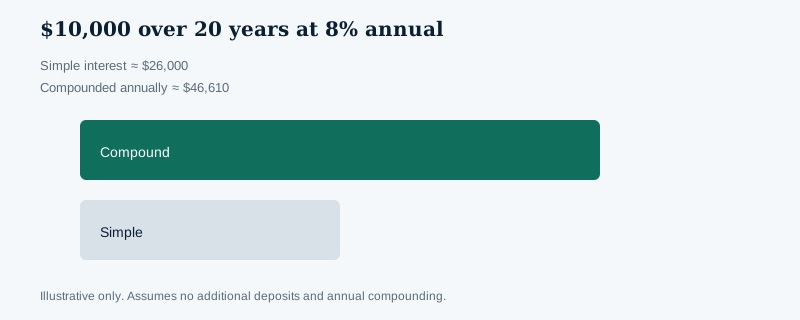
Simple interest is calculated only on the original principal. If you invest 10,000 at 8% simple interest for 20 years, you earn about 800 each year and finish near 26,000.
Compound interest reinvests interest into the balance. The same 10,000 at 8% compounded annually for 20 years grows to about 46,610. The gap is not a marketing trick — it is the mathematics of reinvestment.
For debt, the same logic works against you: unpaid interest can be added to the balance, so future interest is charged on a bigger amount unless you pay down principal.
The compound interest formula (standard)
The widely used compound interest formula is:
- A = final amount (future value)
- P = principal (starting amount)
- r = annual nominal interest rate as a decimal (8% → 0.08)
- n = number of compounding periods per year
- t = time in years
Interest earned = A − P.
Common values for n: 1 (annual), 2 (semi-annual), 4 (quarterly), 12 (monthly), 365 (daily). More frequent compounding usually produces a slightly higher effective result for the same nominal rate.
Authoritative explainers of the same concept are published by educational finance sites such as Investopedia’s compound interest overview, and you can cross-check projections with the free U.S. SEC Investor.gov compound interest calculator (useful even if you live elsewhere, because the math is universal).
Worked example: 10,000 at 8% for 20 years
Annual compounding
P = 10,000 · r = 0.08 · n = 1 · t = 20
Interest ≈ 36,609.57 (same currency units as P).
Monthly compounding
Same inputs, but n = 12:
Monthly compounding earns a bit more because interest is credited twelve times per year.
These examples assume a fixed rate, no fees, no extra deposits, and no tax drag. Real products often differ — always read the account terms.
Adding monthly contributions
Most savers do not invest a single lump sum. When you add a regular contribution (PMT) at the end of each period, the future value becomes the sum of (1) the compounded principal and (2) the future value of an ordinary annuity:
This is the structure behind most “savings goal” and retirement contribution calculators. FinToolyBox’s upcoming SIP / investment calculator will use the same approach so you can model contributions in any currency.
Effective annual rate (EAR): compare offers fairly
Two products can both say “8%” and still deliver different results if compounding differs. The effective annual rate converts a nominal rate into a true yearly growth factor:
Example: 8% nominal compounded monthly → EAR ≈ 8.30%. When you compare banks or loan offers, compare EAR (or your country’s legally required APR-style disclosure), not only the marketing percentage.
The Rule of 72 (quick mental math)
A fast estimate for doubling time is the Rule of 72: divide 72 by the annual rate. At roughly 8%, money doubles in about 9 years if returns compound and rates stay constant. It is a shortcut — not a substitute for the full formula — but it helps you feel the power of time.
How to use a compound interest calculator (step by step)
- Enter your starting principal.
- Enter the annual rate as a percent (the tool should convert to a decimal).
- Choose compounding frequency (monthly is common for savings apps).
- Set the number of years (and months if available).
- Optionally add monthly contributions.
- Read final balance, total contributions, and total interest separately.
- Stress-test with a lower rate and a higher fee assumption.
What the formula does not include
- Account fees and fund expense ratios
- Taxes on interest or capital gains (rules differ by country — see our tax rates guide)
- Inflation (purchasing power may grow slower than the nominal balance)
- Variable market returns (stocks do not pay a fixed compound rate every year)
- Currency conversion if your income and investments use different currencies
Treat calculator output as an estimate for education and planning conversations — not a guarantee.
Compound interest and debt
The same mathematics that helps savers can hurt borrowers. Credit cards and some loans charge interest on outstanding balances; if you pay only the minimum, interest keeps compounding on a slowly declining principal. That is why understanding EMI amortization matters — our guide on how EMI is calculated shows how each installment splits into interest and principal.
If you are estimating coverage needs for dependents while you carry debt, pair this reading with how much life insurance you need.
Common mistakes to avoid
- Using 8 instead of 0.08 in a manual formula
- Ignoring compounding frequency when comparing products
- Forgetting fees that silently reduce the effective rate
- Assuming past investment returns will repeat forever
- Comparing pre-tax growth with after-tax spending needs
Helpful resources
Internal resources
- FinToolyBox finance calculators
- How EMI is calculated
- Understanding tax rates across countries
- How much life insurance do you need?
- All FinToolyBox articles
- Disclaimer
External resources
- Investor.gov — Compound Interest Calculator (SEC)
- Investopedia — Compound Interest
- Investor.gov — Compound interest glossary
Sources & References
This article relies on verified financial standards and official policy frameworks. For official guidelines, consult:
- U.S. Securities and Exchange Commission (SEC) Investor Education
- Financial Industry Regulatory Authority (FINRA)
- Federal Reserve Economic Data (FRED)
Frequently asked questions
What is the compound interest formula?
A = P(1 + r/n)nt, where A is the ending balance, P the start amount, r the annual rate as a decimal, n the compounds per year, and t the years.
Is compound interest the same in every country?
The mathematics is universal. Product rules, fees, advertising disclosures, and tax treatment differ by country and account type.
Does monthly compounding always beat annual compounding?
For the same nominal annual rate, more frequent compounding usually raises the effective annual rate slightly. Always compare effective rates.
Can I use a U.S. calculator if I live elsewhere?
Yes for the formula. Enter your own currency units and local rate. Tax and product rules still depend on where you live.