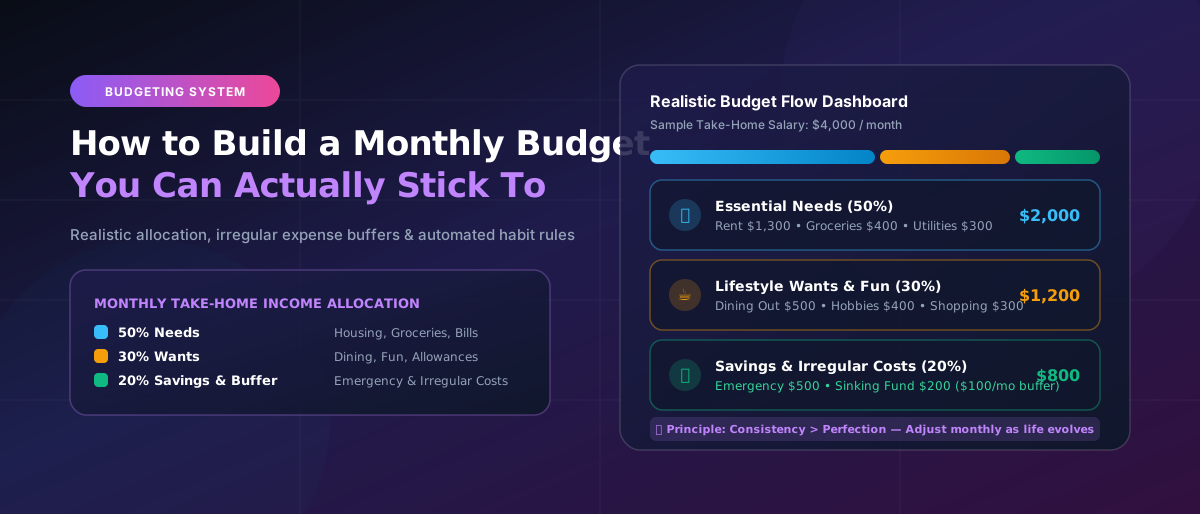
A successful budget isn't about perfection or extreme restriction—it's about consistency. Base your budget on net take-home pay, separate needs from wants, account for irregular annual costs by dividing them by 12, and automate your savings.
Creating a budget sounds simple: add up your income, list your expenses, and make sure the numbers work. In reality, sticking to a budget can be much harder.
Maybe you've tried budgeting before and lasted a few weeks before giving up. Or perhaps your budget looked perfect on paper but didn't leave enough room for unexpected expenses, social plans, or the occasional purchase you simply wanted to make.
The problem may not be that you're bad with money. Your budget may simply be too complicated or unrealistic.
A good monthly budget shouldn't make you feel trapped. It should help you understand where your money is going and give you a clear plan for what you want it to accomplish.
Start With Your Real Monthly Income
The first step is figuring out how much money you actually have available each month.
If you receive a regular salary, this can be relatively straightforward. Use your take-home pay rather than your gross salary when building a spending budget, because your take-home pay is what actually reaches your account.
If your income changes from month to month, budgeting requires a little more flexibility. You can use an average from previous months or build your basic budget around a conservative estimate of what you expect to earn.
The goal is to avoid creating a spending plan based on income you aren't certain you'll receive.
Separate Needs From Wants
Once you know your income, list your regular expenses. One of the easiest ways to organize them is by separating needs from wants.
Needs are expenses that are generally necessary for your household or financial commitments. These might include:
- Rent or mortgage payments
- Utilities (electricity, water, internet)
- Groceries
- Transportation & fuel
- Insurance premiums
- Minimum debt payments
- Essential healthcare costs
Wants are expenses that make life more enjoyable but aren't necessarily essential. They could include restaurant meals, entertainment, subscriptions, hobbies, shopping, or expensive upgrades.
This doesn't mean wants are bad. A budget that completely removes everything enjoyable is unlikely to be sustainable (see how to lower expenses without feeling broke).
| Expense Category | Description & Purpose | Examples |
|---|---|---|
| Essential Needs | Non-negotiable costs required for basic living & legal commitments. | Housing, utilities, groceries, health insurance, loan minimums. |
| Lifestyle Wants | Discretionary spending that adds enjoyment to everyday life. | Dining out, streaming services, hobbies, vacations, shopping. |
| Savings & Sinking Funds | Money set aside for future goals & non-monthly obligations. | Emergency fund, annual insurance, home deposit, retirement. |
Don't Forget Irregular Expenses
This is where many budgets go wrong.
You might successfully account for rent, groceries, transportation, and your monthly bills, only to be surprised when an annual insurance payment, school expense, vehicle repair, birthday, or holiday arrives.
These expenses aren't necessarily emergencies. They're simply expenses that don't happen every month.
The Irregular Expense Buffer Calculation (Sinking Fund)
Estimate all non-monthly expenses for the full year and divide by 12:
- Car Insurance & Registration: $600 / yr
- Annual Subscriptions & Tech: $240 / yr
- Holidays & Birthdays: $360 / yr
Total Annual Irregular Costs: $1,200 ÷ 12 months = $100 / month buffer.
By setting aside $100 every month into a dedicated buffer account, you eliminate surprise financial spikes when annual bills arrive.
Give Your Savings a Job
Saving money becomes easier when you know what you're saving for.
Instead of simply writing “save money” in your budget, create specific categories such as:
- Emergency fund (see how to build an emergency fund step by step)
- Home deposit
- Vacation fund
- Car repairs & maintenance
- Education savings
- Retirement (see how much to save for retirement by age)
- Other long-term goals
Specific goals make your progress easier to see. Saving $200 toward “something someday” can feel meaningless. Saving $200 toward a $2,000 emergency fund gives the money a clear purpose.