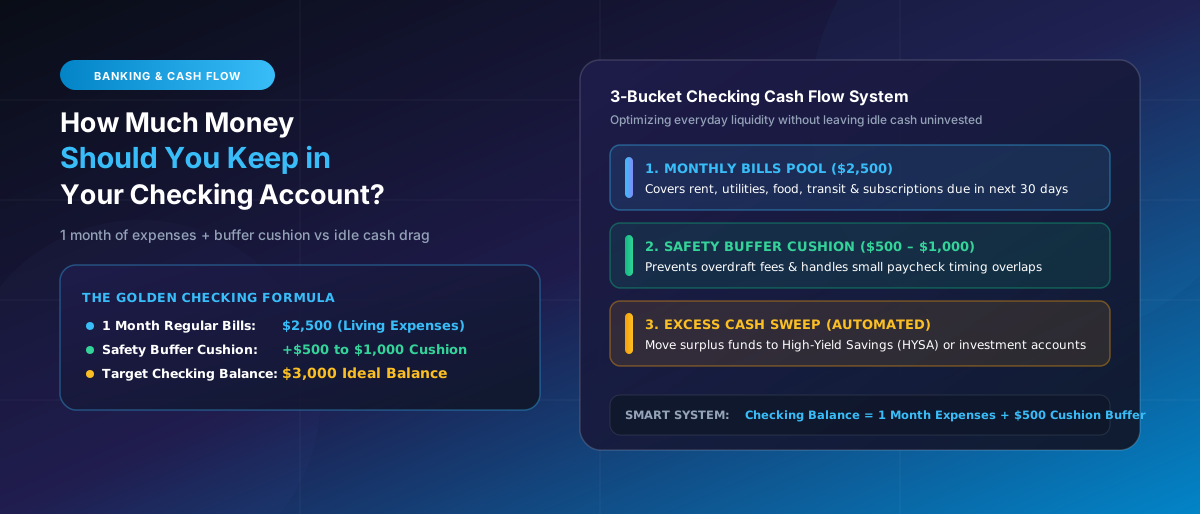
Your checking account is a short-term transaction hub, not a long-term savings vault. Aim to keep roughly 1 month of essential living expenses plus a $500 to $1,000 overdraft buffer cushion in checking. Automatically transfer excess cash to a High-Yield Savings Account (HYSA) to avoid cash drag.
Your checking account is where everyday money usually lives. Your salary may arrive there, bills are paid from it, and you may use the account for groceries, transportation, subscriptions, and other regular expenses.
But how much money should actually stay in your checking account?
Keeping too little can leave you scrambling when several bills arrive at once. Keeping too much may mean money sits idle when it could be working toward savings, debt repayment, or other financial goals.
There is no single amount that works for everyone. The right balance depends on your monthly expenses, income schedule, spending habits, and how much cash you keep in other accounts.
What Is a Checking Account Supposed to Do?
A checking account is primarily designed for everyday transactions. It gives you easy access to money when you need to pay bills, make purchases, withdraw cash, or transfer funds.
Because of that, you generally do not need to keep your entire savings balance in checking. Instead, think of your checking account as your short-term spending account.
Your emergency fund and long-term savings can usually be kept separately, while your checking account handles the money you expect to spend soon.
A Simple Starting Point: One Month of Expenses
For many people, keeping around one month of essential expenses in checking can be a useful starting point.
For example, imagine your regular monthly expenses look like this:
- Rent or housing: $1,200
- Utilities: $200
- Food and groceries: $400
- Transportation: $250
- Phone and internet: $100
- Other regular expenses: $350
Your monthly spending would be about $2,500. Having roughly that amount available in checking could give you enough room to handle normal bills without constantly worrying about the account balance.
However, this is only a starting point. Someone with highly predictable expenses might keep less, while someone with irregular income may prefer a larger checking buffer.
Target Checking Balance Calculation Example
Assume monthly essential living expenses of $2,500 / month:
1 Month Essential Expenses ($2,500) + Overdraft Buffer Cushion ($500) = $3,000 Target Balance
Any cash remaining in checking above $3,000 is automatically swept into a High-Yield Savings Account (HYSA) earning 4%+ APY.
| Earner Profile | Monthly Essential Bills | Recommended Checking Buffer | Total Ideal Checking Balance | Action for Excess Funds |
|---|---|---|---|---|
| Bi-Weekly W2 Employee | $2,500 / month | +$500 cushion | $3,000 balance | Sweep excess to HYSA / IRA |
| Freelance / Variable Income | $3,500 / month | +$1,500 cushion | $5,000 balance | Deposit surplus to Income Buffer |
| Dual-Income Household | $5,000 / month | +$1,000 cushion | $6,000 balance | Automate joint investment goals |
| Minimalist Single Earner | $1,800 / month | +$300 cushion | $2,100 balance | Transfer extra to debt or savings |
Consider Your Pay Schedule
When you get paid can make a big difference.
If you receive a regular paycheck every two weeks, you may not need to keep several months of spending in your checking account. Money is regularly replenished.
On the other hand, if you are self-employed, work on commission, or receive income at irregular intervals, keeping a larger cash buffer may make sense (read how to save money with irregular income).
For example, if your income can vary significantly from month to month, you may want enough money in checking to cover upcoming bills even when your next payment is smaller than expected.
Don't Confuse Checking Money With an Emergency Fund
One common mistake is treating the checking account balance as an emergency fund.
Your checking account should generally cover normal, near-term expenses. Your emergency fund is meant for unexpected financial problems, such as a major repair, sudden loss of income, or another serious expense (see where to store your emergency fund savings).
Keeping these purposes separate can make your finances easier to manage.
For example, you might have $3,000 available for upcoming expenses in checking and another $8,000 in a separate emergency savings account. The checking balance pays the bills, while the emergency fund remains available if something unexpected happens.