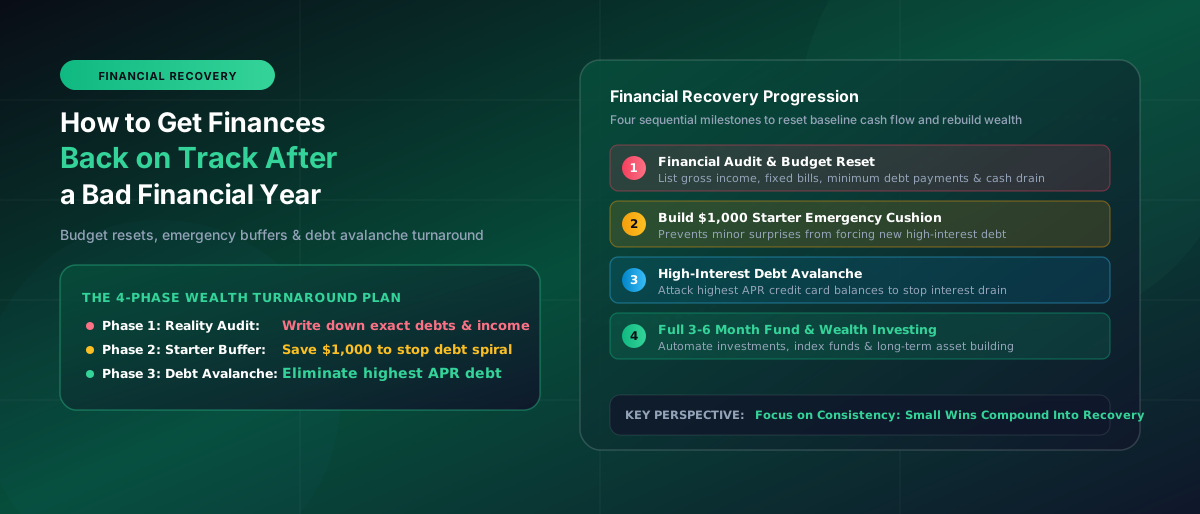
A setback year doesn't define your financial future. Audit your exact current income and debts, build a realistic baseline budget, establish a $1,000 starter emergency buffer, and use the debt avalanche method to eliminate high-interest balances systematically.
Sometimes, despite your best efforts, a financial year simply doesn't go as planned.
You may have taken on unexpected debt, spent more than you earned, dealt with a major emergency, lost income, or simply struggled to keep up with your financial goals. When that happens, it's easy to feel like you've fallen too far behind to recover.
But one difficult financial year doesn't have to define your future.
The important thing is to stop looking backward with regret and start looking forward with a clear plan. Getting your finances back on track is usually less about making one dramatic change and more about taking a series of practical steps.
The 4-Phase Financial Turnaround Roadmap
Rather than attempting an extreme, unmaintainable overhaul, follow this structured progression:
Phase 1: Reality Audit & Budget Reset (Uncover exact numbers)
Phase 2: $1,000 Starter Emergency Buffer (Stop taking new debt)
Phase 3: High-APR Debt Avalanche (Eliminate interest drain)
Phase 4: Full 3-6 Month Fund & Wealth Investing (Automate growth)
| Recovery Phase | Target Timeline | Primary Action Item | Expected Financial Impact |
|---|---|---|---|
| Phase 1: Audit & Reset | Month 1 | List all debts, income, & fixed expenses | Clear visibility; stops panic guessing |
| Phase 2: Starter Buffer | Months 1 – 2 | Save $1,000 liquid emergency fund | Prevents minor surprises from adding debt |
| Phase 3: Debt Avalanche | Months 3 – 12 | Pay off highest APR credit cards first | Saves thousands in interest costs |
| Phase 4: Full Wealth Rebuild | Months 12+ | Expand buffer to 3-6 months & invest | Establishes permanent wealth stability |
Start by Understanding What Went Wrong
Before changing your financial habits, figure out what actually caused the problem.
Was your income lower than expected? Did your expenses increase? Did you rely heavily on credit cards? Were there unexpected medical, housing, transportation, or family expenses?
Look through your bank statements, bills, loan balances, and other financial records. Try to identify the biggest reasons your finances became difficult.
This isn't about blaming yourself. It's about finding the problem so you can address it.
Take a Clear Look at Your Current Numbers
After a difficult year, avoiding your financial accounts can feel tempting. Unfortunately, not knowing the numbers usually makes the situation harder to fix.
Write down:
- Your current net monthly income
- Your mandatory essential monthly expenses
- Your current cash savings balance
- Your outstanding debt balances and interest rates
- Your minimum monthly debt payments
- Your major upcoming annual expenses
Once everything is visible, you can make decisions based on facts instead of guesses.
Build a Realistic Budget Again
If your previous budget stopped working, don't simply recreate it and hope things improve (learn how to build a monthly budget you can stick to).
Build a budget based on your current reality.
Start with essential expenses such as housing, food, utilities, transportation, insurance, and minimum debt payments. Then determine how much remains for savings, debt repayment, and discretionary spending.
If your income changes from month to month, consider building your budget around a conservative estimate rather than your best month.
Focus on Your Most Expensive Debt
High-interest debt can make financial recovery much slower because a significant portion of your payments may go toward interest.
Make at least the required payments on all debts, then consider directing extra money toward the debt with the highest interest rate. This is commonly known as the debt avalanche method (see snowball vs. avalanche debt payoff guide).
Another option is the debt snowball method, where you focus on the smallest balance first. It may not always minimize interest as efficiently, but some people find the quick wins motivating.
The best approach is one you can realistically maintain.
Rebuild Your Emergency Fund
If an emergency forced you to use your savings, don't consider the setback a failure. That's exactly what emergency savings are designed for (see storing emergency cash safely).
Once the immediate crisis has passed, start rebuilding the fund.
You don't necessarily need to replace the entire balance immediately. Start with a small target and gradually work toward having enough to cover several months of essential expenses, depending on your circumstances.
Even a modest cash buffer can help prevent the next unexpected expense from turning into new debt.
Cut Expenses Without Making Your Life Miserable
When finances are tight, it can be tempting to eliminate every enjoyable expense.
That approach may work temporarily, but an extremely restrictive budget can be difficult to maintain.
Instead, look for expenses that provide little value. Cancel unused subscriptions, compare service providers, reduce unnecessary convenience spending, cook at home more often, and reconsider expensive recurring commitments.
Focus first on expenses that can be reduced without significantly affecting your quality of life.