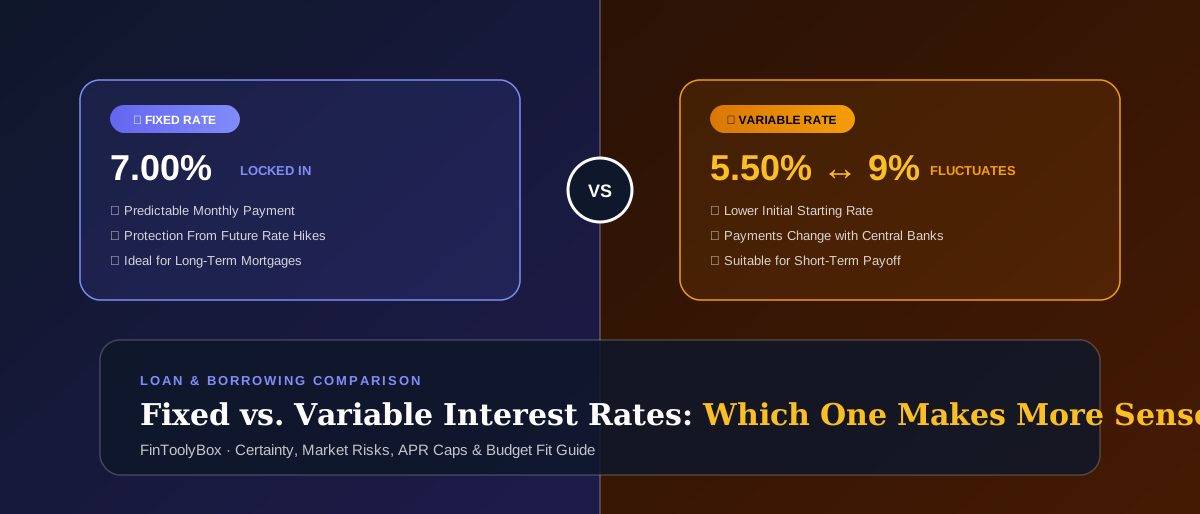
A fixed interest rate offers guaranteed monthly payment stability and protects you from central bank rate hikes. A variable interest rate starts lower but carries the risk of payment increases if market rates rise.
When you're taking out a loan, the interest rate is one of the most important details to understand. But knowing the rate isn't enough. You also need to know whether that rate is fixed or variable.
The difference can affect your monthly payment, the total amount you repay, and how predictable your finances are over the life of the loan.
So which option is better? There isn't one answer for everyone. The right choice depends on the type of loan, the available rates, how long you expect to keep the loan, and how comfortable you are with changes in your payments.
What Is a Fixed Interest Rate?
A fixed interest rate stays the same for the agreed-upon period of the loan.
For example, suppose you take out a loan with a fixed interest rate of 7%. Assuming there are no other changes to the loan terms, the interest rate remains 7% rather than moving up or down with market conditions.
This makes fixed-rate loans easier to plan for because your interest rate is predictable.
For many borrowers, that predictability is one of the biggest advantages.
What Is a Variable Interest Rate?
A variable interest rate can change over time based on the terms of the loan and the underlying benchmark or index it is tied to (see how central bank rates work).
You might start with a lower rate than you would get with a fixed-rate option, but that rate could increase or decrease later.
For example, imagine a loan begins with a 6% variable rate. If the rate changes according to the loan's terms, your interest rate could move higher or lower in the future.
That means your monthly payment may also change, depending on how the loan is structured.
Fixed vs. Variable: A Side-by-Side Comparison
| Feature | Fixed Interest Rate | Variable Interest Rate |
|---|---|---|
| Payment Predictability | 100% Guaranteed Stable | Fluctuates with benchmark rates |
| Starting Interest Rate | Typically slightly higher initially | Often lower initial starting rate |
| Market Rate Hike Risk | Zero risk (protected) | Higher payments if rates rise |
| Best Suited For | Long-term loans (Mortgages, 5yr+ Auto) | Short-term loans or quick payoffs |
Neither option is automatically cheaper. What matters is how the rate behaves over the entire period you have the loan.
The Biggest Advantage of a Fixed Rate
The main benefit of a fixed rate is certainty.
If your loan payment is already difficult to fit into your budget, knowing that the interest rate won't suddenly increase can provide valuable financial stability.
This can be particularly useful when you're planning your monthly expenses several years into the future.
It also protects you if market interest rates rise significantly after you take out the loan (see what happens when interest rates go up).
The Biggest Advantage of a Variable Rate
The biggest potential advantage of a variable rate is that you may receive a lower starting rate.
If rates remain low or decrease, you could potentially pay less interest than you would have with a higher fixed rate.
However, that benefit comes with uncertainty. A variable rate that looks attractive today could become much more expensive if rates rise.
What Happens When Interest Rates Rise?
This is where the risk of a variable rate becomes more obvious.
Suppose your loan begins with a relatively low variable interest rate. Later, the rate increases. Depending on your loan terms, your monthly payment could rise or a larger portion of your payment could go toward interest.
If you have a tight monthly budget, even a moderate increase can become uncomfortable (see why loan payments are higher than expected).
Before choosing a variable rate, ask yourself an important question:
The Critical Variable Rate Stress Test
"Could I still comfortably afford this loan if the interest rate increased by 2% to 3%?"
If the answer is no, a fixed-rate option provides necessary financial protection.
Don't Look Only at the Starting Rate
One of the easiest mistakes borrowers make is comparing only the initial interest rates.
A variable loan might advertise a lower starting rate than a fixed loan, making it look like the obvious winner.
But the starting rate is only part of the story. You should also look at:
- How often the variable rate can change
- What benchmark or index affects the rate
- Whether there are cap limits on rate increases
- Whether your monthly payment can change
- Fees and other loan costs (see how to calculate real loan cost)
- How long you expect to keep the loan
- The total amount you could repay under different scenarios
Reading the full loan terms is important because two variable-rate loans can work very differently.
Which Option Is Better for a Long-Term Loan?
For a loan you expect to keep for many years, predictability can become especially valuable.
A fixed rate can make long-term budgeting easier because you have greater certainty about your interest rate.
A variable rate might still make sense if you understand the risks, have enough financial flexibility to handle higher payments, or expect to repay or refinance the loan relatively quickly.
However, don't assume refinancing will always be available. Future interest rates, your financial situation, and lender requirements can all change.
What About Short-Term Borrowing?
If you expect to repay a loan relatively quickly, a variable rate may sometimes be worth considering because you may benefit from a lower initial rate without carrying the loan for many years.
But the potential savings should always be weighed against the possibility of rate increases.
The shorter the period you plan to borrow, the less time there may be for rate changes to affect you—but there is still no guarantee that rates will move in your favor.
Think About Your Financial Personality
Interest rates aren't just a mathematical decision. They can also affect how comfortable you feel about your finances.
If you prefer knowing exactly what your payment will look like and don't like surprises, a fixed rate may be more suitable.
If you are comfortable accepting some uncertainty in exchange for the possibility of a lower cost, you may be more comfortable with a variable rate.
Use a Loan Calculator Before Deciding
A loan calculator can help you compare different interest-rate scenarios.
For a fixed-rate loan, you can estimate your payment and total interest based on the loan amount, rate, and term.
For a variable-rate loan, you can also consider hypothetical situations where the interest rate rises or falls.
8 Questions to Ask Before Choosing
- What is the starting interest rate?
- Can the rate change in the future?
- How often can it change?
- Is there a maximum cap rate or payment increase?
- What fees are included in the APR?
- How long do I expect to keep the loan?
- Could I comfortably afford the payment if rates increased?
- What would the total cost be under different rate scenarios?
The Bottom Line
Fixed and variable interest rates each have advantages and disadvantages.
A fixed rate offers greater predictability and protects you from future rate increases. A variable rate may offer a lower starting rate and could become cheaper if rates fall, but it also exposes you to the possibility of higher borrowing costs.
Instead of choosing based solely on the lowest advertised rate, look at the entire loan and consider how it fits into your financial situation.
The best interest rate isn't necessarily the lowest rate today. It's the option whose risks and costs you can comfortably manage throughout the time you expect to have the loan.
Sources & References
This rate comparison guide relies on central banking rules and consumer credit disclosures. For official resources, visit:
- Consumer Financial Protection Bureau (CFPB) Fixed vs Adjustable Rates
- Federal Reserve Economic Data (FRED) Benchmark Rates
- Federal Trade Commission (FTC) Credit Terms Guide
Frequently asked questions
What is the main benefit of a fixed interest rate loan?
The main benefit is complete monthly payment certainty. Your interest rate and payment stay unchanged throughout the agreed term, protecting you if market rates rise.
Why do borrowers choose variable interest rates?
Variable rate loans often offer lower initial starting interest rates than fixed-rate loans. If market rates remain low or decrease, the borrower pays less total interest.
Which rate type is better for long-term borrowing like mortgages?
For long-term borrowing (15-30 years), fixed rates are generally preferred by budget-conscious buyers because they eliminate the risk of payment shock if central bank rates rise.
Helpful resources
Internal resources
- How to Calculate Real Cost of a Loan
- Why Loan Payments Are Higher Than Expected
- What Happens When Interest Rates Go Up
- How Central Bank Interest Rates Work
- Browse all articles