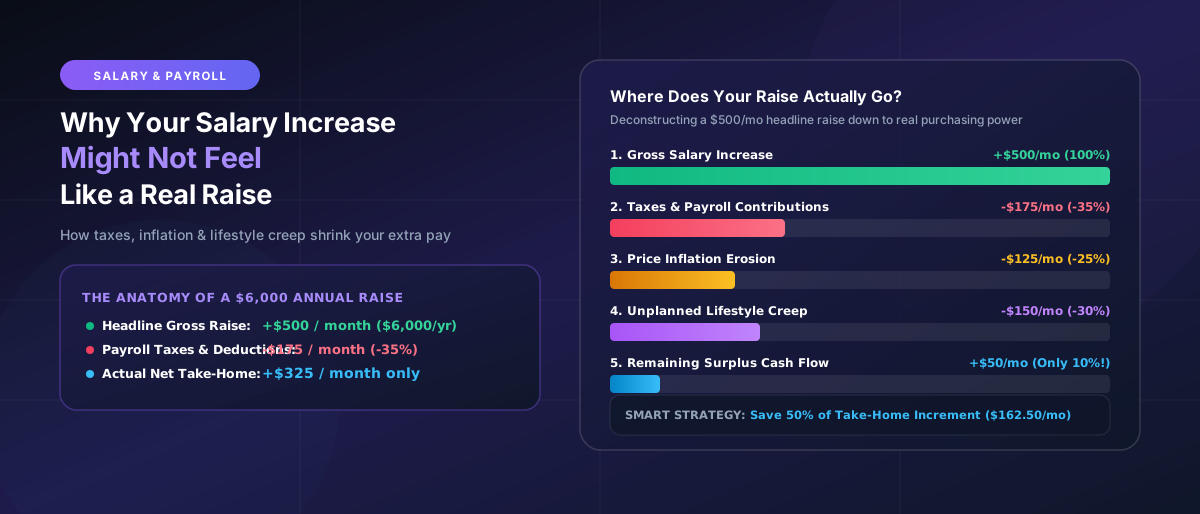
A headline salary raise rarely translates dollar-for-dollar into bank account growth. Payroll taxes, inflation, automatic retirement contributions, and lifestyle inflation silently absorb much of your pay increase. To keep your raise, calculate your net take-home increment and automate savings before the money is spent.
Getting a salary increase should feel exciting. You see a higher number on your paycheck, and naturally, you expect to have more money left over at the end of the month.
But sometimes that doesn't happen.
You earn more than you did before, yet somehow your bank account doesn't seem much healthier. You may even wonder where the extra money went.
This is surprisingly common. A raise can improve your financial situation, but several things can quietly reduce how much of that increase you actually feel.
Your Raise Isn't the Same as Your Take-Home Increase
The first thing to understand is that a salary increase usually isn't added dollar-for-dollar to your take-home pay.
When your gross salary increases, more money may go toward income taxes, retirement contributions, social insurance, or other payroll deductions depending on where you live and how you're paid.
For example, imagine your salary increases by $6,000 per year. That sounds like an extra $500 per month, but you may receive considerably less than $500 in additional take-home pay after deductions.
This doesn't mean the raise wasn't valuable. It simply means you should judge the increase based on your net income, not just the headline salary figure.
Headline Salary Increase vs. Actual Cash Flow Example
Suppose you receive a headline salary raise of $6,000 / year ($500 / month):
Gross Raise: +$500/mo → Taxes & Deductions (-$175/mo) → Net Take-Home: +$325/mo
Out of a headline $500 monthly raise, your liquid cash flow only increases by $325. If inflation adds $125 in costs, your real gain shrinks to just $200 per month.
| Annual Gross Raise | Monthly Gross Increase | Est. Taxes & Payroll (-30% to -35%) | Actual Net Monthly Cash | Recommended 50% Auto-Savings |
|---|---|---|---|---|
| $3,000 / year | $250 / month | -$80 / month | +$170 / month | $85 / month |
| $6,000 / year | $500 / month | -$175 / month | +$325 / month | $162.50 / month |
| $10,000 / year | $833 / month | -$290 / month | +$543 / month | $271.50 / month |
| $15,000 / year | $1,250 / month | -$440 / month | +$810 / month | $405.00 / month |