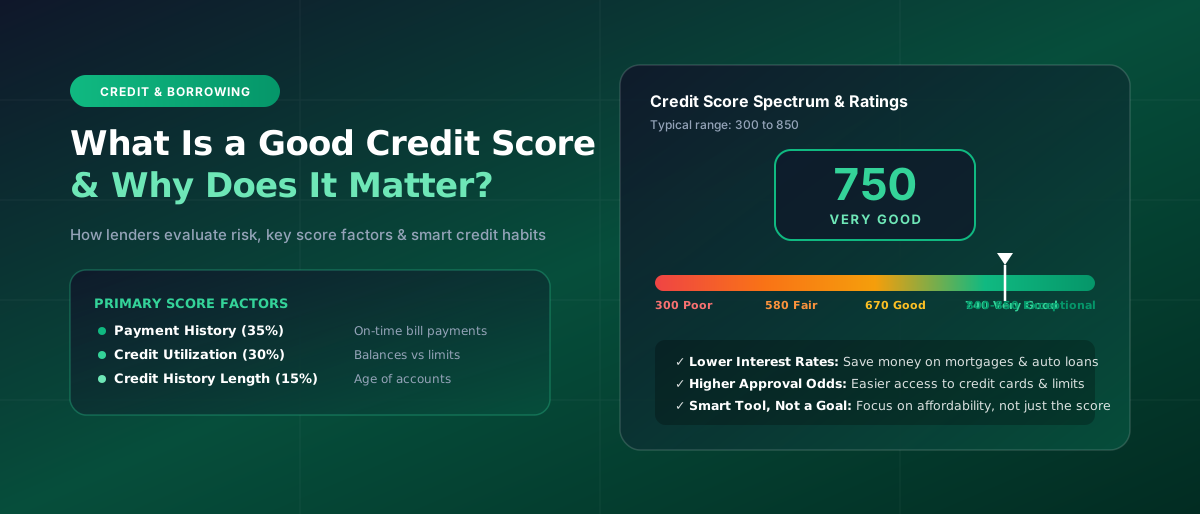
A credit score is a numerical estimate of your borrowing risk based on your credit history. While higher scores grant access to lower interest rates and better terms, your credit score is a decision-making tool—not a reason to take on unnecessary debt.
Your credit score is one of those numbers that can quietly affect many parts of your financial life. You might not think about it every day, but when you apply for a loan, credit card, mortgage, or another form of credit, that number can suddenly become very important.
The good news is that you don't need to be a financial expert to understand your credit score. Once you know what it means, what affects it, and how lenders may use it, it becomes much easier to manage.
What Is a Credit Score?
A credit score is a number designed to help lenders estimate how likely you are to repay borrowed money based on information in your credit history.
Different countries use different credit-reporting systems, scoring models, and score ranges. In many places, a higher score generally suggests a stronger credit history, while a lower score can indicate a higher level of lending risk.
Your score isn't a complete picture of your financial life. Someone can have a good income and plenty of savings but still have a limited or poor credit history. Likewise, someone with a strong credit score may not necessarily have a large income.
Think of your credit score as one financial signal—not a complete financial report card.
So, What Counts as a Good Credit Score?
There isn't one universal number that qualifies as “good” everywhere.
Credit-score ranges depend on the country, credit bureau, and scoring model being used. That's why you should always check which scoring system applies to you rather than assuming that a particular number means the same thing everywhere.
| Score Rating Range | Typical Score Range (FICO Model) | Lender Risk Perception & Impact |
|---|---|---|
| Poor | 300 – 579 | High risk. Approval difficult; requires collateral or high rates. |
| Fair | 580 – 669 | Moderate risk. Standard qualification; higher interest rates. |
| Good | 670 – 739 | Acceptable risk. Strong approval odds with competitive rates. |
| Very Good | 740 – 799 | Low risk. Access to premium borrowing terms & rate discounts. |
| Exceptional | 800 – 850 | Lowest risk. Lowest available interest rates & instant approvals. |
In general, the goal is to build a credit history that shows responsible borrowing and repayment. A stronger credit profile can make it easier to qualify for certain financial products and may give you access to more competitive borrowing terms (see fixed vs variable interest rates).
Why Does Your Credit Score Matter?
Your credit score can matter because lenders use credit information when evaluating applications. A lender may consider your score alongside your income, existing debts, employment situation, collateral, and other factors (see what your debt-to-income ratio says about your finances).
A stronger credit profile may help you:
- Qualify for certain loans or credit cards
- Receive more favorable interest rates in some situations
- Access higher credit limits
- Reduce the cost of borrowing (see how to calculate the real cost of a loan)
- Have more financial options when you need credit
However, having a good score doesn't guarantee approval. Every lender has its own requirements, and your complete financial situation can matter just as much as the score itself.