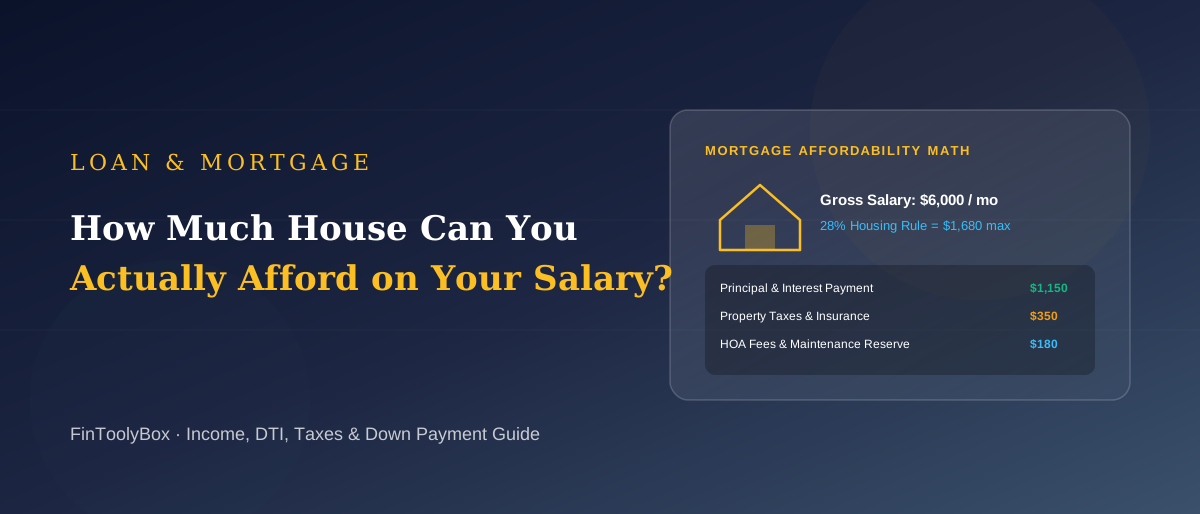
The goal isn't to buy the most expensive home a bank approves. Calculate your housing budget from your net comfortable monthly cash flow—accounting for property taxes, insurance, maintenance, and existing debts—rather than multiplying your salary by a fixed number.
Buying a home is exciting, but there is one question you should answer before you start scrolling through property listings: How much house can you actually afford?
Your salary is an important part of the answer, but it is not the whole story. A home that looks affordable based on your income alone can become stressful once you add property taxes, insurance, maintenance, utilities, debts, and other everyday expenses.
The goal is not to buy the most expensive house a lender is willing to approve. The goal is to find a home that fits comfortably into your life.
Start With Your Monthly Income
The first step is to look at your reliable monthly income. If you earn a regular salary, this is fairly straightforward. If your income changes from month to month, you may want to use a conservative average rather than your best month.
For example, imagine you take home $5,000 per month. It might be tempting to immediately calculate a mortgage based on that number, but you also need to look at what is already leaving your account every month.
Car payments, student loans, credit cards, childcare, insurance, subscriptions, and other obligations can all affect how much room you really have for a mortgage.
Don't Forget the Other Costs of Owning a Home
A mortgage payment is only one part of the cost of owning a house.
Depending on where you live and the property you purchase, you may also have to budget for:
- Property taxes
- Homeowners insurance
- Mortgage insurance (PMI), if applicable
- Homeowners association (HOA) fees
- Utilities (Electricity, Water, Heating, Trash)
- Repairs and ongoing maintenance
- Unexpected home emergency expenses
This is why looking only at the advertised mortgage payment can give you a misleading picture of affordability.
The 28% Rule Is Only a Starting Point
You may have heard of the general guideline that housing costs should stay around 28% of your gross monthly income. It can be a useful starting point, but it should not automatically determine your budget.
Suppose your gross monthly income is $6,000. Twenty-eight percent would be $1,680.
That does not necessarily mean you should spend exactly $1,680 every month on housing. Your other debts and living expenses could make that amount comfortable, difficult, or somewhere in between.
Think of these percentages as planning tools rather than rules you must follow.
Your Debt Matters Too
One of the biggest mistakes potential homeowners make is focusing on salary while ignoring existing debt.
Imagine two people who both earn $6,000 per month. One has almost no debt, while the other has large car, student loan, and credit card payments.
On paper, they earn the same amount. In reality, they have very different amounts of money available for a mortgage.
This is where your debt-to-income ratio (DTI) can be useful. It compares your monthly debt obligations with your gross monthly income and gives you a clearer picture of how much of your income is already committed.
How a Home Affordability Calculator Can Help
You do not have to work through all the numbers manually.
A home affordability calculator can help you estimate a reasonable home price by considering factors such as your income, down payment, interest rate, loan term, property taxes, insurance, and existing debts.
Instead of asking only, “What will the bank lend me?” you can ask a more useful question: “What monthly payment can I comfortably live with?” Try our home loan affordability guide for full details.
Consider Your Down Payment
Your down payment can have a major effect on the amount you need to borrow.
A larger down payment generally means a smaller loan balance. That can reduce your monthly principal and interest payment and may also affect mortgage insurance requirements, depending on the loan and location.
However, putting every dollar you have into the down payment is not always a good idea.
You still need money for closing costs, moving expenses, repairs, furniture, and emergencies. Being “house rich” but having almost no cash left in the bank can create problems shortly after moving in.
Interest Rates Can Change the Picture
The interest rate on your mortgage can make a significant difference in your monthly payment and the total amount you pay over the life of the loan (as explained in our rising interest rates guide).
For example, two buyers could purchase similarly priced homes but end up with noticeably different monthly payments because they received different interest rates or chose different loan terms.
This is why it is important to calculate the payment using a realistic interest rate rather than assuming that today's most attractive advertised rate will automatically apply to you.
Don't Forget About Future Expenses
Your financial situation today may not look the same five years from now.
Maybe you plan to have children, change careers, start a business, replace a car, or take on another major expense. A mortgage that barely fits your budget today could become uncomfortable if your circumstances change.
Before buying, leave yourself some breathing room. A home should be part of your financial plan, not the thing that consumes almost every dollar you earn.
Example: A $5,000 Monthly Income Budget
Sample Affordability Scenario ($5,000 Gross Income)
- Gross Monthly Income: $5,000
- 28% Housing Rule Benchmark: $5,000 × 0.28 = $1,400 max
- Target Comfortable Monthly Budget: $1,250 – $1,400 (P&I + Taxes + Insurance)
- Existing Monthly Debt: $300 (car loan)
- Total Debt-to-Income (DTI): ($1,350 housing + $300 car) / $5,000 = 33% DTI (Very healthy!)
The important point is that the affordable home price comes from the monthly budget, not simply from multiplying your salary by a fixed number.
Questions to Ask Before Buying
Before committing to a home, ask yourself:
- How much do I have available for a down payment?
- How much will I have left after closing?
- What are my current monthly debts?
- Can I comfortably handle the estimated housing payment?
- Have I included property taxes and homeowners insurance?
- Do I have an emergency fund set aside?
- What happens if my income decreases?
- Will I still be able to save for retirement and other goals?
Final Thoughts
So, how much house can you afford on your salary?
The answer depends on much more than your paycheck. Your debts, down payment, interest rate, taxes, insurance, savings, and future plans all matter.
Rather than buying the most expensive home you qualify for, consider choosing a price that leaves room in your budget for saving, emergencies, and enjoying life.
A mortgage is a long-term commitment. Taking the time to calculate your true housing budget before you buy can help you avoid financial stress later.
Sources & References
This home buying guide relies on housing regulatory standards and mortgage disclosures. For official guidance, visit:
- Consumer Financial Protection Bureau (CFPB) Owning a Home Guide
- U.S. Department of Housing and Urban Development (HUD)
- Fannie Mae Homebuyer Resources
Frequently asked questions
What is the 28% rule for home buying?
The 28% rule suggests that your total monthly housing costs (principal, interest, property taxes, and homeowners insurance) should not exceed 28% of your gross monthly income.
Why is your Debt-to-Income (DTI) ratio important for mortgage approval?
DTI measures how much of your gross income goes toward existing debts (car loans, student debt, credit cards). Lenders use DTI to ensure your total debt including the new mortgage stays within safe limits (usually under 36% to 43%).
Should I use all my savings for a down payment?
No. Using all your savings leaves you "house rich but cash poor" with no reserves for closing costs, moving expenses, initial maintenance, or unexpected emergencies.
Helpful resources
Internal resources
- Home Loan Affordability Guide
- Understanding Debt-to-Income (DTI) Ratio
- How Property Tax Is Calculated
- Homeowners vs Renters Insurance
- How to Calculate Real Cost of a Loan
- Browse all articles